When recruiters look at my CV, they always snag on the same line. They scan past the Master’s in Networking and Computer Science degree, and they stop at “Extended Care Assistant” as work experience.
They look up, usually with a polite, confused smile. “That’s a bit of a pivot,” they say. “From looking after the elderly to looking after servers.”
They are wrong. It wasn’t a pivot. It was a lateral move.
The technology industry is obsessed with “soft skills” right now. They want empathy, communication, and crisis management. But you do not learn those in a sterile classroom or a three-day boot camp. You learn them at 7:00 AM in an aged care facility when you are short-staffed, the buzzer board is lighting up like a Christmas tree, and a resident has had a fall in the corridor.
My time in the Australian aged care sector did not just pay the bills while I studied. It was the ultimate operational boot camp for IT Support and Cybersecurity. Here is why the nursing home floor is the best training ground for the Service Desk and Security Operations Centre (SOC).
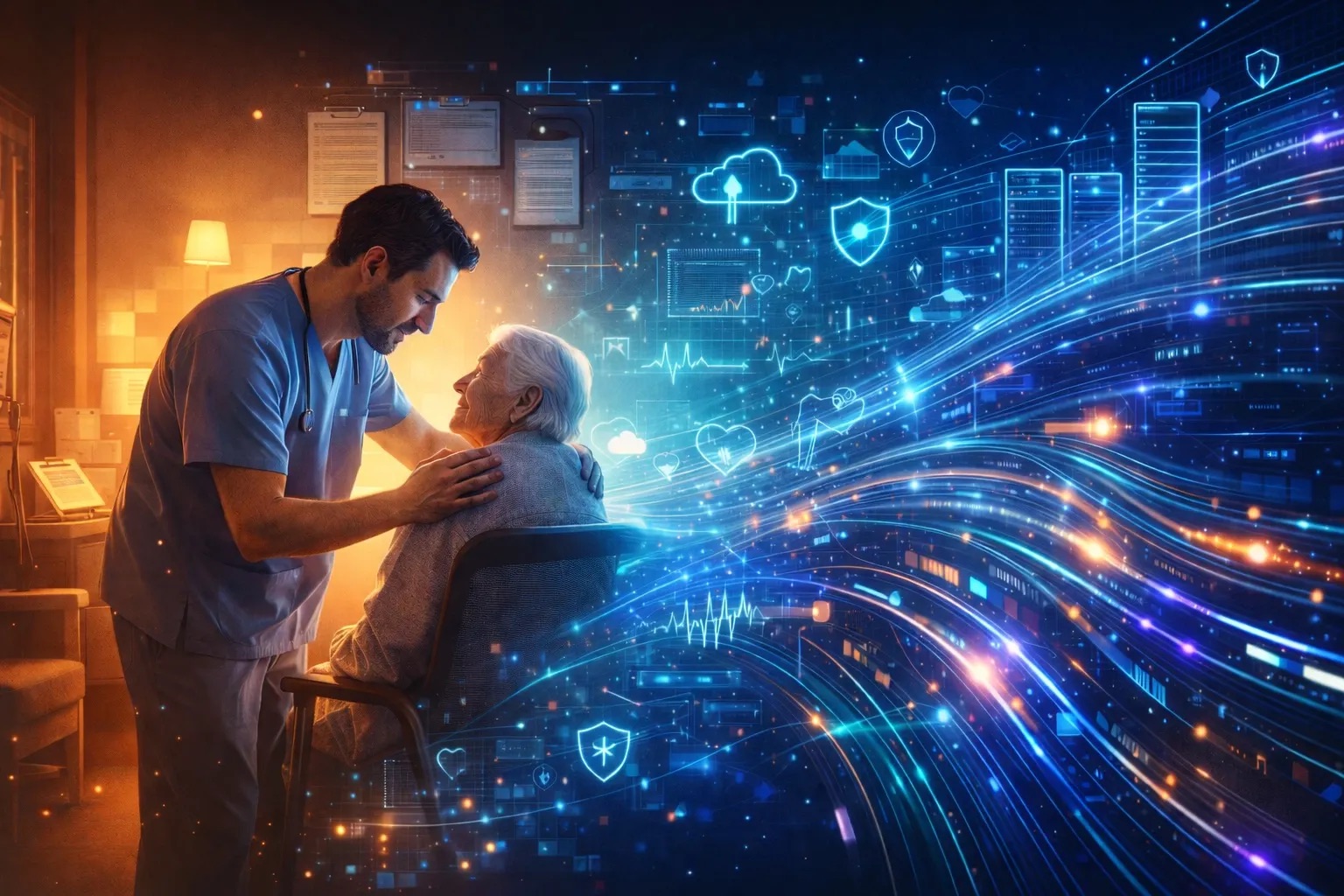
Image Generated using AI: Bridging the gap between healthcare triage and IT incident management.
1. Triage is Just Incident Management with a Pulse
In IT, we talk endlessly about Incident Management and SLAs (Service Level Agreements). We categorise tickets: P1 (Critical), P2 (High), P3 (Standard). Junior analysts often panic when the queue blows out; they freeze or try to cherry-pick the easy password resets while the Exchange server burns.
In healthcare, you do not get to freeze.
You walk onto a shift and assess the floor instantly. One resident is shouting for a cup of tea. Another is showing signs of a chest infection. A third is wandering towards the exit door. You do not serve the tea first just because it is easy. You secure the exit, you check the sick resident’s vitals, and you tell the tea-drinker you will be there in five minutes.
That is active triage.
When a frantic user calls me because their screen is black, I do not just hear a complaint. I am instinctively checking for a pulse: Is this a single-user error? Or is the whole network down? I treat a server outage like a medical emergency and a password reset like a “cup of tea” request. My blood pressure does not spike because I know the difference between an inconvenience and a critical system failure.
2. Infection Control is the Original Cyber Hygiene
In security, we talk about “containing the breach” and “maintaining hygiene.” To a fresh graduate, these are abstract concepts. To me, they are muscle memory.
In aged care, infection control is not a theory; it is a rigid protocol. If a resident has a contagious virus, you follow strict compliance standards. You isolate the room (quarantine), you don PPE (firewall), and you wash your hands before touching anyone else to stop the spread (network segmentation). One slip-up, and the whole facility goes down.
This maps directly to cybersecurity frameworks.
- The Virus: Malware or Ransomware.
- The Isolation: Disconnecting the infected machine from the network.
- The PPE: Antivirus and Endpoint Detection and Response (EDR) systems.
I do not just understand security policies; I enforce them. I have operated in an environment where cutting corners on protocol could literally cost a life. I am not going to let anyone bypass security controls or click a phishing link on my watch.
3. ‘Vitals’ are Just System Logs
A significant part of being a carer is proactive observation. You do not wait for a resident to collapse; you monitor for subtle indicators. Is their breathing shallow? Is their skin flushed? Is their baseline behaviour slightly off today?
We call these “Taking Vitals.” In IT, we call it Log Monitoring and Threat Hunting.
A competent SOC Analyst does exactly what I did on the night shift. They monitor the dashboard for anomalies. They look for the digital equivalent of a fever — an unexpected spike in CPU usage, an anomalous login time, or degraded network performance.
Because of my background, I am trained to identify the pattern before the crash. I do not wait for the server to fail; I notice it is “breathing funny” and investigate the root cause immediately.
4. The ‘Layer 8’ Problem (Dealing with Humans)
Technologists often complain about “Layer 8” issues — the human between the chair and the keyboard. They get frustrated when users do not understand basic terminology.
Try explaining to a confused resident with dementia why they cannot go home to their parents who passed away thirty years ago.
You cannot use jargon. You cannot get angry. And you definitely cannot use logic to win the argument. You must validate their reality, de-escalate the anxiety, and seamlessly guide them to a solution that makes them feel secure.
That is exactly the core of IT Service Management.
When a stakeholder is stressed because their VPN is disconnected before a major deadline, they are not being difficult; they are feeling helpless. I do not lecture them on IP addressing. I use my “Aged Care voice.” I validate the stress, de-escalate the situation, and restore their operational capability. I translate complex technical routing into plain English, the same way I translated medical jargon for worried families. If you can manage a distraught relative, a frustrated Project Manager is a walk in the park.
5. Documentation: The Ultimate Audit Trail
In regulated healthcare, non-compliant documentation has severe legal and operational consequences.
You must document clinical observations, fluid intake, and behavioural changes with precision. You learn very quickly that “I think he seemed fine” is not a legally defensible audit trail.
Moving into the technology sector, I observed that many technicians close tickets with a simple “Fixed.”
I do not. I document the symptoms, the troubleshooting methodology, the root cause, and the applied resolution. Why? Because historical data dictates future success. Knowing a resident had a reaction to medication three months ago saves their life today. Knowing a switch port flapped last Tuesday helps me diagnose a spanning-tree loop today.
ServiceNow, Jira, and ConnectWise are not chores. They are patient charts, and I maintain them with absolute compliance.
Conclusion
If you are reading this and trying to transition into technology from a “non-technical” background — whether it is nursing, retail, or hospitality — stop apologising for it.
Do not hide that operational experience at the bottom of your CV. Highlight it as a strategic advantage.
Anyone can learn to configure a router. I can teach a junior analyst Python syntax in a month. But I cannot teach them how to care. I cannot teach them how to read a room, how to prioritise under fire, or how to treat an end-user like a human being rather than a ticket number.
I am not just an IT professional. I am a caregiver who learned to engineer and secure networks. And that makes me exceptionally better at both.